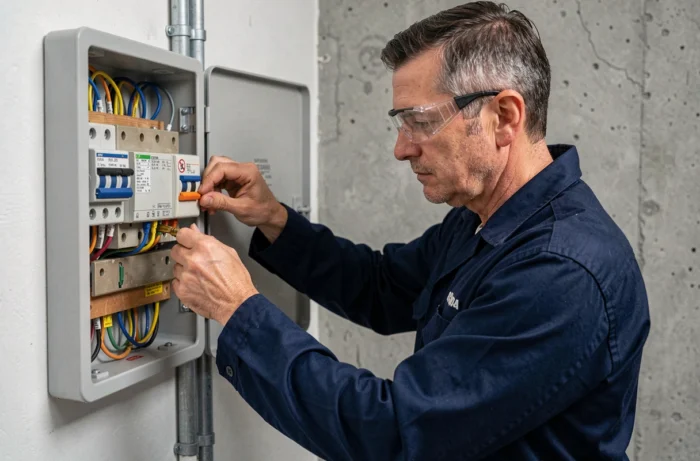
A 10A circuit breaker on a roller shutter circuit is not a default rating. It is a more restrictive protection choice than the maximum allowed by the NF C 15-100 standard, which tolerates up to 16A for 1.5 mm² conductors. This rating imposes specific constraints on the number of motors connected and on the sizing of the circuit, constraints that we detail here to avoid unwanted tripping.
Inrush current of motors and actual margin on a 10A circuit breaker
The nominal power of a roller shutter motor is low in steady state. The problem arises at startup: the inrush current of a single-phase asynchronous motor can reach several times its nominal current for a fraction of a second.
A type C circuit breaker (the residential standard) tolerates a peak between five and ten times its rating before instant magnetic tripping. At 10A, this gives a peak tolerance between 50 and 100A. This threshold seems comfortable for a single motor, but the situation changes radically when multiple shutters start simultaneously, for example via a centralized control or a home automation scene.
We recommend checking the technical data sheet of the motor (Somfy, Simu, Bubendorff, or others) to know the actual starting current. Adding the inrush currents of all the motors on the circuit gives the theoretical maximum peak. If this value exceeds the magnetic threshold of the circuit breaker, the circuit will trip with each grouped command.
Find E-City’s advice for roller shutters for a detailed step-by-step approach to the connections.
Number of roller shutters per 10A circuit breaker: calculation rule
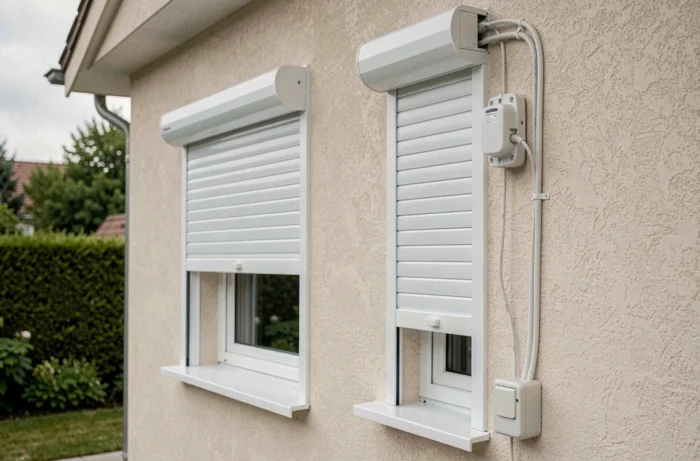
The NF C 15-100 standard does not directly set a maximum number of roller shutters per circuit. It regulates the cross-section of conductors, the rating of the circuit breaker, and the type of differential protection. The number of motors results from the calculation of the cumulative current, not from a flat rule.
The method is as follows:
- Check the nominal current of each motor on its nameplate or technical documentation (generally less than 1A for a standard shutter).
- Add the nominal currents of all motors planned on the circuit.
- Ensure that the total remains below the rating of the circuit breaker with a safety margin, typically 80% of the rating, which is 8A for a 10A circuit breaker.
- Consider the length of the circuit and voltage drops, especially in large houses where the panel is far from the shutters.
In practice, most installers limit the connection to five roller shutters on a 10A circuit breaker. This empirical limit covers the majority of motors on the market, but it is not absolute: a wide bay window motor consumes more than a standard window motor.
Distribution of roller shutter circuits in the electrical panel
Grouping all shutters on a single circuit is a common mistake. In case of tripping, all motorized openings become unusable. We regularly observe this problem in renovations where the panel has not been resized.
The best practice is to create several dedicated circuits, distributed by area (floor, facade) or by usage. Each circuit has its own circuit breaker and connects to a 30 mA AC type differential switch, sufficient for roller shutter motors without a DC component.
Star or daisy chain wiring
Two topologies exist to power multiple shutters from the same circuit breaker. Star wiring runs from the panel to a junction box, then distributes an individual cable to each motor. Daisy chaining goes from one shutter to the next in series.
Star wiring facilitates diagnosis in case of failure and isolates each motor. Daisy chaining reduces the amount of cable but makes troubleshooting more complex. In both cases, connections must be made in accessible junction boxes, never in shutter boxes, to meet maintenance requirements.
Update NF C 15-100 edition 2024 and impact on shutter circuits
The NF C 15-100 standard has been profoundly reorganized in 2024. The old structure from 2002, supplemented by five amendments, has been replaced by a series of 21 standards published on August 23, 2024. This new edition has become the reference for new or fully renovated installations starting in September 2025.
For roller shutter circuits, the fundamental requirements remain stable: dedicated circuit, minimum cross-section of 1.5 mm², maximum 16A circuit breaker. A 10A rating remains compliant, provided that the cumulative current calculation justifies this choice.
The reorganization into 21 standards mainly changes the numbering of the sections and how control offices check compliance. If you are renovating a complete panel, the Consuel will apply this new structure during the inspection. We recommend keeping the manufacturer’s documentation for each motor in the technical file of the installation, as inspectors now rely on manufacturer data to validate the sizing of protections.
The choice between a 10A and 16A circuit breaker depends on the number of motors, their unit power, and the length of the circuit. For a home with fewer than five shutters on the same circuit and reasonable wiring distances, the 10A effectively protects without oversizing. Beyond that, switching to a 16A avoids tripping and offers room for expansion if you add shutters later.