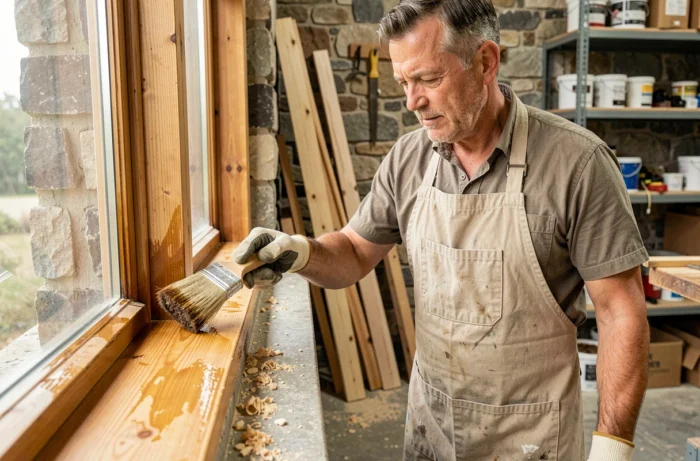
On a south-facing cladding or shutters that work in every season, traditional wood stain shows its limits after a few years. Polyurethane stain provides a technical solution to this problem: a film that is more resistant to abrasion and superior mechanical performance on stressed woodwork. However, this promise of durability deserves close examination, as polyurethane is not a universal shield.
Polyurethane film on exterior woodwork: what the technical data sheet doesn’t always say
The term polyurethane is often associated with near-total protection. In reality, the situation is more nuanced. The film formed by a polyurethane stain is hard and resistant to friction, making it suitable for surfaces exposed to abrasion: door thresholds, handrails, covered terrace floors.
On the other hand, this hardness can become a disadvantage on very mobile wood. Seasonal dimensional variations (swelling in winter, shrinking in summer) put the film under tension. If the formulation does not incorporate enough flexibility, micro-cracks appear. Water seeps in, gets trapped under the film, and the wood begins to rot without any visible signs on the surface.
To explore the advantages of polyurethane stain in detail, it is important to distinguish between interior formulations, which are rigid by design, and exterior formulations that include plasticizers to accommodate the movement of the wood.
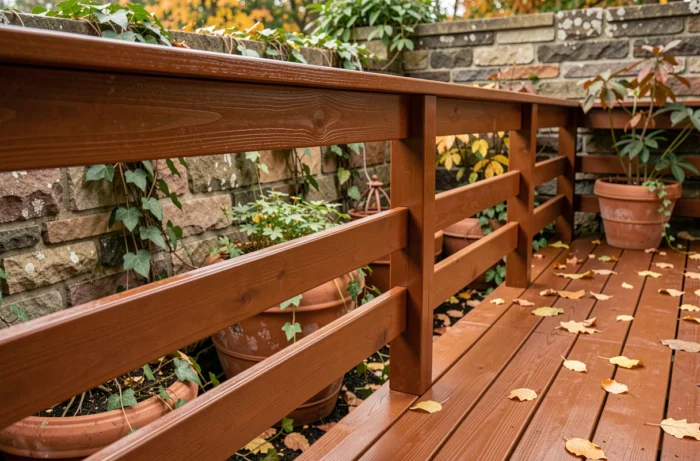
One point that commercial data sheets rarely mention: an exterior polyurethane finish is not a permanent waterproofing. On a horizontal surface where water stagnates (top of a railing, window sill), the film degrades faster than on a well-drained vertical surface.
UV resistance of polyurethane stain: pigmentation and transparency
UV resistance is a recurring selling point for polyurethane stains. On this point, there is often confusion: polyurethane as a binder does not automatically provide UV protection. It is the overall formulation that matters, particularly the presence of UV filters and pigments.
A transparent stain, even polyurethane, degrades faster under the sun than a tinted stain. Radiation penetrates the film, reaches the wood, and causes a gradual graying. Over time, the finish may also take on an unsightly amber hue.
Before purchasing, check two elements in the technical data sheet:
- The explicit mention of UV protection with an indication of the type of filter or absorber used, not just the mention “resists UV”
- The pigmentation rate: a tinted semi-transparent stain protects significantly better than a colorless stain on exposed wood
- The compatibility with the targeted wood species, as some softwoods exude tannins that can interfere with the film
Feedback on this point varies depending on exposure and region. A north-facing cladding in Brittany does not experience the same UV stress as a south-facing shutter in Provence. The actual lifespan of the protection depends as much on the context as on the product itself.
Polyurethane stain or saturator: which product for which support
The saturator penetrates the wood without forming a surface film. The polyurethane stain, on the other hand, creates a protective layer that remains on the surface. This is not a cosmetic detail: the choice between film and impregnation conditions future maintenance.
A saturator is easily renewed: clean, then apply a new coat. No need to sand. A polyurethane stain that starts to peel requires careful sanding before reapplication, or it risks creating unsightly and less adherent buildups.
When to favor polyurethane stain
The polyurethane stain makes the most sense on woodwork that undergoes repeated physical contact. Entrance doors, garden gates, railings: these elements need a film resistant to mechanical abrasion, which a saturator cannot provide.
It is also suitable for interior woodwork exposed to wear (stairs, kitchen furniture, solid wood countertops), where its hardness becomes a real asset without the constraints of external expansion.
When the saturator is more suitable
On a wooden terrace, cladding, or garden shed, the saturator offers waterproof protection without the risks of peeling. The wood breathes, and moisture naturally escapes. Maintenance is less technical, and the matte “oiled wood” finish appeals to those looking for a natural look.
Surface preparation and application: mistakes that ruin durability
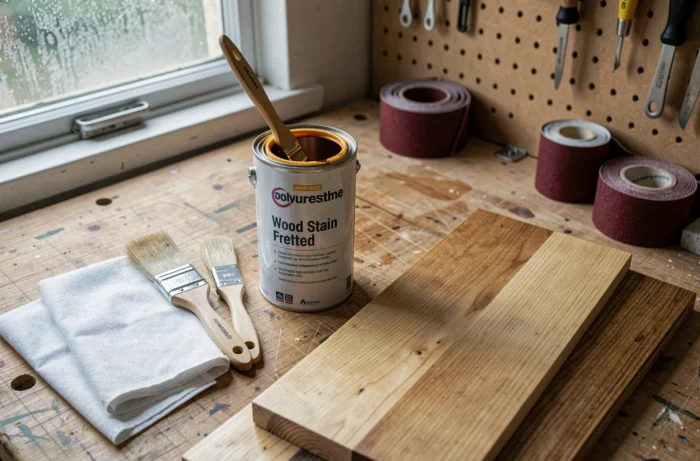
The quality of surface preparation directly determines the longevity of the finish. On new wood, start with fine sanding to open the fibers and promote product adhesion. On already treated wood, all traces of the old coating must be removed, especially if it is a varnish or film-forming paint.
Applying a polyurethane stain on a poorly prepared surface guarantees premature peeling. Adhesion depends on the direct contact between the binder and the wood fibers. A dusty, greasy, or damp surface compromises this adhesion from the first coat.
Some concrete points of vigilance:
- Check that the wood’s moisture content is sufficiently low before application, as overly damp wood traps water under the film
- Respect the drying time between coats indicated by the manufacturer, even if the surface seems dry to the touch
- Avoid applying in direct sunlight or high heat, which causes too rapid drying on the surface and poor product penetration
Generally, two to three coats are applied to achieve complete protection. Each coat should be thin and even. It is better to have three thin coats than one thick coat that risks running and leaving marks.
The polyurethane stain remains a high-performance finishing product when used on the right support, under the right conditions. Its mechanical resistance distinguishes it from other stains on woodwork subjected to wear. On surfaces highly exposed to the elements and standing water, a saturator or a flexible stain will often be more reliable in the long term. The choice of product matters, but the rigor of preparation and application is at least equally important.