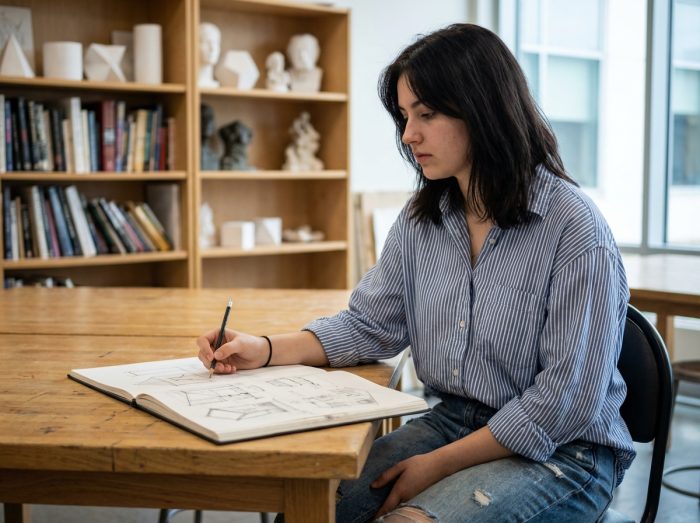
Some institutions now require a preparatory course before accepting any candidate, even those already holding an artistic degree. However, direct admission remains possible in other schools, provided that the candidate has an exceptional portfolio. The increase in hybrid programs further complicates the paths. Success in competitions does not solely depend on acquired technical skills. The choice of path, the profiles of candidates, and the nature of the tests create different strategies depending on the schools and fields.
Hybrid training in design: understanding a new pathway to prestigious schools
Today, it is impossible to navigate the design field without encountering these famous hybrid programs. Their strength? Combining the discovery of fundamentals, teamwork, and initial immersions in the professional world, guided by practitioners close to the field. Now, the design preparatory year before a prestigious art school has become a preferred route for many. Jurors closely examine portfolios: every detail matters, every project choice can make a difference.
This detour through a preparatory course serves as an essential transmission belt. Here, students explore drawing, art history, creative thinking, methodology, as well as practical workshops that require confronting collective work. In one year, this path helps build a solid trajectory, clarify desires, and strengthen one’s portfolio in front of the meticulous selection processes of higher education institutions.
But fundamentally, technique is never enough. These programs provide students with a sort of compass: better self-knowledge, affirmation of a unique artistic language, discovery of the sector’s truths, between concepts, constraints, and concrete realizations. Thus, approaching the competitions of higher art schools or design becomes primarily a matter of commitment, curiosity, and the search for meaning. Regardless of preferences—public school, private structure, or hybrid path—this foundational year shapes profiles capable of facing demanding and multifaceted curricula.
Design preparatory course, university, or traditional curriculum: what advantages and limitations based on your profile?
The design preparatory course is not just a technical gateway. It offers real support, personalized advice, and, above all, regular feedback to evolve one’s portfolio. If you come from another field, are self-taught, or have practiced art little in high school, this step secures the leap to higher education. It refines desires, broadens creative palettes, and concretely measures the areas to be worked on before entering the competitions of prestigious schools.
On the university side, the approach differs: priority is given to general culture and theory, diversity of teachings, but with a more distant handling. For some, artistic practice is sorely lacking, support suffers from distance, and it becomes riskier to build a striking portfolio. Faced with crowded lecture halls, opportunities for creation diminish, complicating direct access to specialized schools.
If the choice is made for a school dedicated to design, everything changes. Students literally dive into practice, alternating workshops, internships, and sometimes missions in companies. This format, focused on professionalization and supported by strong networks of graduates, appeals to those who have already defined a viable project and can defend a quality artistic portfolio from the start.
Let’s take a moment to clearly compare these different paths:
| Path | Main Advantages | Limitations |
|---|---|---|
| Design preparatory course | Individualized support, rich portfolio, intensive experimentation | Sometimes tough selection, costs to anticipate |
| University | Intellectual openness, broad theoretical foundation | Limited specialization, little artistic practice |
| Specialized school | Professional immersion, multiple networks and internships | Selectively admission, requirement for a well-thought-out project |

What competitions and opportunities after hybrid training in design?
Following a design preparatory course that emphasizes workshops, visual culture, and fundamentals opens the doors to a variety of entrance competitions in French schools. The Beaux-Arts de Paris, ENSAD, Estienne, or Olivier de Serres recruit based on the portfolio, creative tests, and interviews. Here, the portfolio developed throughout the preparatory year becomes a concentric asset: it demonstrates not only your achievements but also the originality of your approach and the coherence of your reflection.
To join ENSCI-Les Ateliers or the École supérieure de design de Troyes, admission is through competition or portfolio. These schools seek sharp profiles capable of linking artistic sense, keen criticism, and understanding of the contemporary design world. The hybrid training prepares candidates for this cocktail of requirements. If the desire for international experience emerges, institutions like the Royal College of Art or the Design Academy Eindhoven first examine concrete achievements and the ability to work in English from the first meeting.
Succeeding in these steps goes far beyond just holding a diploma. It means stepping fully into the professional design world. The professional horizons are vast: graphic designer, product designer, motion designer, art director. The support of an active alumni network, projects completed during internships or workshops, all contribute to accelerating access to employment and enriching the journey. This preparatory year acts as a launchpad, facilitates applications abroad, and nurtures the confidence to pursue atypical paths.
In this changing environment, choosing a design preparatory course is neither a luxury nor a constraint, but a step capable of broadening horizons. A few months to solidify one’s project, assert oneself, and take the time to build a path that can withstand the demands of the most prestigious schools: this detour, for many profiles, yields more gains than losses.