
In game design, the reality of teamwork is played out in the daily frictions between professions, much more than in mastering a game engine. From the very first production meeting, a game designer, an artist, and a programmer often realize that they do not break down the project in the same way.
Cultural Bias in Teams: The Invisible Risk of Game Design
When a team designs a progression system or a dialogue tree, each member projects their own player references. A French designer accustomed to narrative RPGs does not segment difficulty in the same way as a colleague raised on Korean mobile games. These reflexes often go unnoticed.
The problem reveals itself during playtesting. A mechanism that seems intuitive to the team confuses testers from a different cultural background. The reward icon, the pace of tutorials, the tolerance for failure: all of this varies according to local gaming habits.
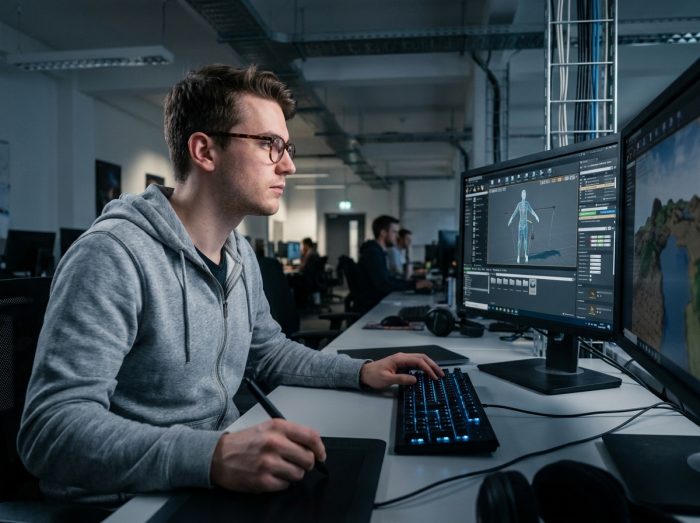
Current training rarely addresses this angle. Level design, prototyping, and technical documentation are taught. But identifying one’s own player biases remains an exercise absent from curricula. In the studio, it is often the first shock for a junior: realizing that their intuition of “good gameplay” is not universal. To better understand teamwork in game design, one must accept that every design decision carries a cultural imprint.
In practical terms, a simple exercise consists of having a prototype tested by players who do not share the team’s references, and then confronting the feedback in a meeting. This confrontation forces the group to distinguish between a deliberate design choice and a collective blind spot.
Collaborative Prototyping: Tools and Methods That Change Daily Life
A few years ago, team prototyping involved back-and-forth file exchanges, competing versions, and misunderstandings about layer names. Collaborative tools like Miro and Figma, now adapted to game design workflows, have shortened playtest cycles in French independent studios.
The difference does not lie in the software itself. It lies in what it makes visible. On a shared Miro board, each team member sees in real time the annotations of others on a level mockup. The game designer lays out their pacing intentions, the artist points out a readability constraint, the programmer notes a technical limitation. The prototype becomes a living document, not a frozen deliverable.
For a student, learning to work with these tools does not mean mastering the interface. It means knowing how to formulate feedback that is understandable to someone from another profession. Writing “the jump doesn’t work” helps no one. Writing “the jump input window seems too short to chain into the aerial attack” opens a real technical discussion.
What Work-Study Programs Reveal
Game designers coming from work-study programs generally integrate into studios faster than those coming from initial training. Early exposure to production pressure largely explains this gap.
In work-study, the student participates in real sprints with non-negotiable deadlines. They learn to arbitrate between a good idea and an idea that is feasible within the allotted time. This ability to arbitrate is acquired through practice, not theory.
Game Design Documentation: The Real Team Language
A poorly written game design document (GDD) generates more conflicts than a creative disagreement. Documentation is the main channel through which a designer communicates their intentions to other professions in the studio.
Have you ever noticed that the same word can refer to very different things depending on the profiles? “Level” for an artist is a visual environment. For a designer, it is a space of mechanical constraints. For a programmer, it is a set of scripts and triggers. A good GDD defines each term in a shared glossary.
Students often underestimate the volume of documentation that a game designer position requires. It is not an administrative side task. It is the heart of collaborative work. A designer who does not clearly document their intentions produces ambiguity, and ambiguity, in production, translates into lost hours.
- The GDD for mechanics describes the rules, variables, and edge cases of each game system. It must be readable by a programmer without additional oral explanation.
- The level design document maps out pacing intentions, points of interest, and critical paths of a level. The artist uses it to prioritize visual elements.
- The playtest sheets record structured observations after each testing session. They serve as a basis for iteration meetings and prevent the same debates from being repeated.
Cross-Disciplinary Skills in Game Design: What Studios Evaluate During Hiring
Studio recruiters are not only looking for a good portfolio of levels or prototypes. They assess a candidate’s ability to function in a multidisciplinary team under time constraints.
Knowing how to defend a design choice and accepting that it may be invalidated by a playtest constitutes a distinct skill. In interviews, a creative director will often ask a question like: “Tell me about a project where your idea was abandoned. What did you do next?” The answer reveals more than any diploma.
- Critical reading of existing mechanics (analyzing why a game works or fails, not just playing it) demonstrates a maturity of thought that is sought after.
- The ability to rephrase a technical problem in accessible terms for an artist or a producer facilitates daily production.
- The habit of versioning and archiving design documents proves a rigor that studios associate with reliability in a team.

Game design is a profession of constant negotiation between creative vision and production constraints. Students who arrive in the studio with this awareness gain an advantage. Those who expect to impose their ideas solely through the strength of the concept quickly discover that a solid design arises from technical compromises accepted by every profession in the studio.