
Two parents under the same roof, yet two radically different ways of organizing a closet, managing homework, or preparing dinner. A thriving family life does not rely on a perfect alignment between adults. It is built by accepting these differences and finding common ground that lasts over time.
When parents don’t function the same way: adjusting without standardizing
Have you ever noticed that one parent manages mornings with military precision, while the other improvises in the evening without a list or timer? This discrepancy often creates friction, not because there is a problem, but because each measures the other’s involvement against their own way of functioning.
The classic trap is wanting the partner to do things the same way. A parent who sorts the children’s clothes by category and another who piles them into a single drawer are not demonstrating different levels of care. Two distinct methods can produce an equivalent result.
The concrete lever is to distribute tasks according to actual preferences rather than a theoretical equal split on paper. The one who struggles with morning noise takes charge of the evening routine. The one who enjoys cooking manages meals, while the other handles laundry. This distribution based on preference, documented in recent family organization approaches, reduces mental load much more effectively than a theoretical 50/50 chart.
You can find concrete insights on these topics by browsing the family section on Conseils Parentaux, which addresses domestic logistics from both parents’ perspectives.
Family routines and connection rituals: what lasts over time
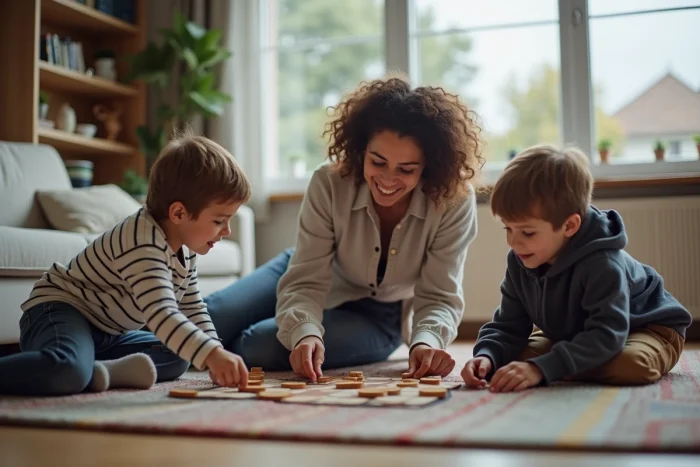
Recent content on parenting converges on one point: regular rituals reduce tensions better than big discussions. A fixed meal on Wednesday evenings, a walk on Sunday mornings, a reading time before bed. What matters is the repetition, not the ambition of the program.
An effective ritual has three characteristics:
- It is short and realistic, between ten and thirty minutes, so it can survive busy weeks without becoming an additional chore
- It involves active presence (no screens in parallel), even if the activity is mundane like preparing a dessert together
- It occurs on a fixed day or time, which secures children by giving them a stable time reference
Families that maintain one or two simple rituals per week often find that daily conflicts lose intensity. The ritual creates neutral ground where no one is right or wrong. We don’t talk about unfinished homework or laundry lying around. We share a moment.
Adapting the ritual to the children’s age
With toddlers, the ritual revolves around sensory experiences: bath, nursery rhyme, cuddle. With elementary school children, it can become more active: board games, cooking, outings to the park. For teenagers, a simple meal without phones already constitutes a powerful connection ritual, as long as it doesn’t turn into a school interrogation.
Family organization tools: simplifying daily logistics
Family organization has taken an operational turn in recent years. We no longer just talk about compassionate communication between parents and children. We talk about concrete systems that streamline household logistics.
The visible task board in the kitchen (paper format or chalkboard) remains a remarkably effective tool. Each family member sees what has been done and what remains to be done. The hidden benefit: it makes visible the invisible domestic work, the one that one parent often absorbs without the other being aware.

Visual routines work particularly well for preschool and elementary school children. An illustrated timeline of morning steps (getting up, getting dressed, having breakfast, brushing teeth) avoids repeating the same instructions over and over. The child gains independence, and the parent saves considerable energy.
- A weekly menu plan displayed on the refrigerator eliminates the daily question “what are we having for dinner” and reduces food waste
- A bin for each child near the entrance, with the next day’s things prepared the night before, streamlines morning departures
- Labels on drawers and storage boxes allow each family member to find and put away things in the right place, including the youngest
A good organization tool solves a specific and recurring problem. If no one uses it after two weeks, it needs to be replaced or simplified. The goal is not a perfect house, but a house where everyone knows what to do without waiting to be asked.
Couple life and parenting: protecting the bond between adults
The couple is often the first casualty in the race of family daily life. Conversations boil down to logistics: shopping, medical appointments, children’s activities. The emotional bond between parents erodes due to a lack of dedicated time, not a lack of love.
Scheduling a regular time for the couple works better than waiting for free time. Thirty minutes after the children go to bed, a coffee on Saturday morning while the kids watch a cartoon, a monthly outing for two. The format matters less than the regularity.
When parents don’t have the same available time (shift work, business trips, unequal domestic load), this couple time requires a conscious organizational effort. The more available parent should not fill all the void left by the other. They should preserve a space where both adults can reconnect outside their parenting roles.
A well-functioning couple does not automatically produce a thriving family. However, a couple that only talks about logistics eventually weakens the entire household. Children perceive the quality of the bond between their parents long before they understand the words exchanged.
Daily family life does not need spectacular recipes. It needs stable references, an honest distribution of tasks, and moments where everyone, both children and adults, feels seen and heard. When parents stop seeking identical functioning and instead build a system that respects their differences, the home gains serenity without anyone having to deny themselves.