
Changing the entrance door of a collective building is not just about swapping out a worn-out door for a new one. Since 2022, each co-ownership has to juggle a range of precise rules: agreement in the general assembly, enhanced safety requirements, new acoustic standards, and sometimes, constraints that are much stricter than those imposed by national law. The color, material, type of locking mechanism—nothing escapes the scrutiny of the regulations or the vigilance of certain neighbors. Ignoring these prescriptions is not without risk: appeals, project delays, or even administrative sanctions can quickly come into play.
What the law requires to replace an entrance door in a co-owned building
In co-ownership, no intervention is taken lightly. Replacing an entrance door, even if it has become inoperative, is never an individual prerogative. The co-ownership regulations serve as a safeguard: they specify the expected characteristics for any modification of the common areas. Material, color, opening system, or access control—all must pass through the filter of the general assembly. The co-owners, gathered for the occasion, hold the final say.
The law strictly regulates this process. Under the law of July 10, 1965, and the decree of March 17, 1967, an absolute majority is required for any decision regarding the common areas. Only the property manager has the authority to include this topic on the agenda, thus avoiding individual initiatives that could jeopardize the harmony of the building.
The regulations for entrance doors in collective buildings go beyond appearance. They require compliance with French standards, notably the NF certification, for fire resistance, sound insulation, and accessibility. The width of the door, its maneuverability, and its compliance with requirements for people with reduced mobility: every criterion counts.
Before considering any quotes, check these key points:
- Consult the co-ownership regulations to know the specific requirements.
- Obtain the agreement of the general assembly.
- Ensure your project complies with French safety and accessibility standards.
No room for approximation. Modifying a collective entrance door is about protecting the building, ensuring safety, and preserving the tranquility of all occupants.
What steps to take in 2024 for a compliant and accepted change?
Before any modification, the process starts with a dialogue with the property manager. They centralize the request, verify the project’s compliance, and then include it in the agenda for the next general assembly. Without this collective green light, it is impossible to start the work, even for a simple like-for-like renovation.
The co-owners do not settle for a simple “yes” or “no.” They analyze quotes, discuss technical solutions, evaluate the proposed aesthetics, and debate issues of safety or comfort. A door suitable for the building’s configuration must meet standards but also integrate harmoniously with the existing structure. The addition of an access control system, or even video surveillance, often fuels the debate.
In Paris and elsewhere, these questions receive particular attention, especially for buildings located in protected areas or open to the public. To avoid any disputes, an absolute majority must be gathered before signing any order form.
Here’s how to proceed step by step:
- Have the request included in the agenda by the property manager.
- Provide detailed quotes and technical sheets to the co-owners.
- Verify the project’s compliance with current standards.
- Obtain written agreement from the general assembly before engaging the company.
By following these steps, the co-ownership ensures a dispute-free installation and a door that meets all legal and practical expectations.
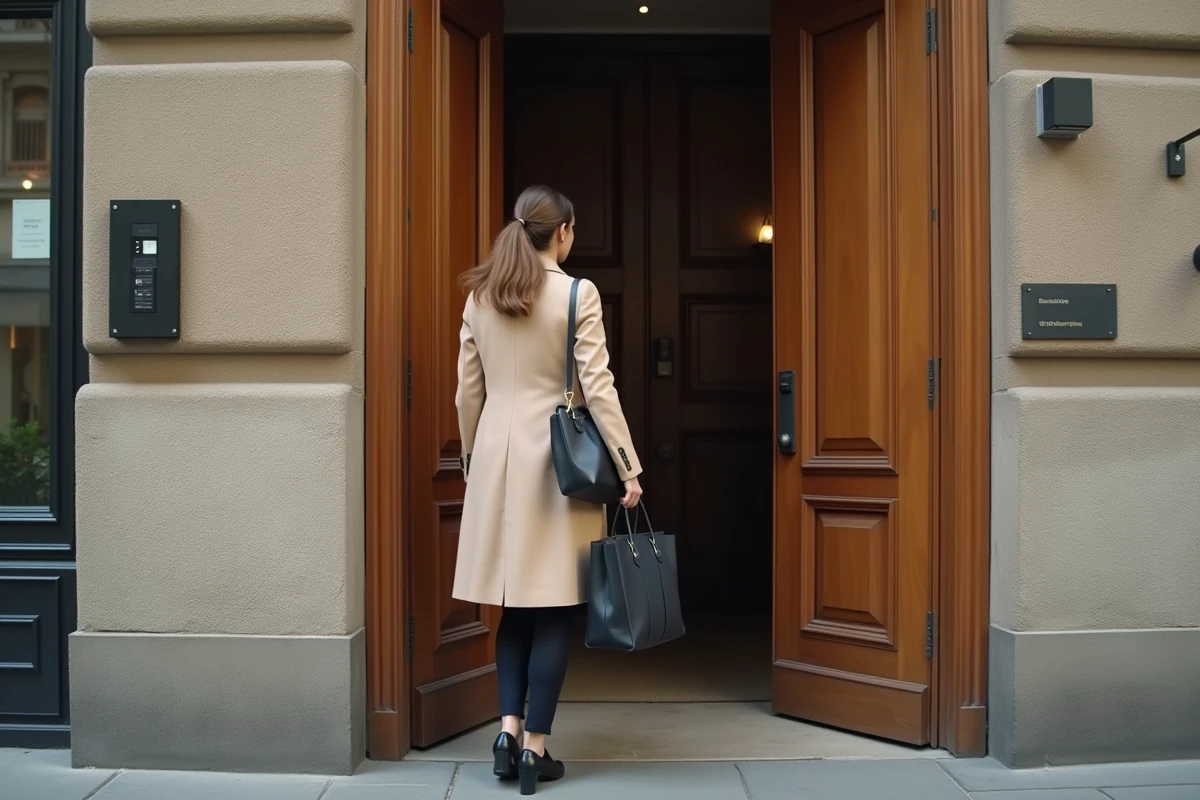
Fire safety, accessibility, technical standards: requirements not to be overlooked when replacing
Replacing the entrance door of a collective building engages the co-ownership’s responsibility on several fronts. First and foremost, fire safety: the fire resistance of the door must correspond to the required classification, often EI30 or EI60 depending on the building’s configuration. This requirement limits the spread of flames in the event of a disaster, thus protecting all residents.
Next comes accessibility. Standards require a minimum width to allow for wheelchair passage, as well as an ergonomic handle, an appropriate threshold, and regulated opening force. Neglecting these details exposes the co-ownership to appeals from people with reduced mobility.
Thermal and acoustic insulation completes the list. A high-performance door reduces heat loss and mitigates noise from outside or common areas. The choice of material—wood, steel, composite—will directly influence these characteristics.
Finally, if the door is equipped with an electronic access system, badge, or keypad, the co-ownership must provide clear information on data usage, in compliance with GDPR.
To ensure compliance, systematically check:
- The presence of a fire-resistance classification suitable for the building.
- The regulatory width of the passage and accessibility for people with reduced mobility.
- Thermal and sound insulation according to French standards.
- Compliance with GDPR in the case of electronic access control.
In a collective building, changing an entrance door is much more than just a simple project: it is a collective act that engages the safety, comfort, and daily life of all. Ignoring the steps risks leaving the door closed… or having to start all over again.