
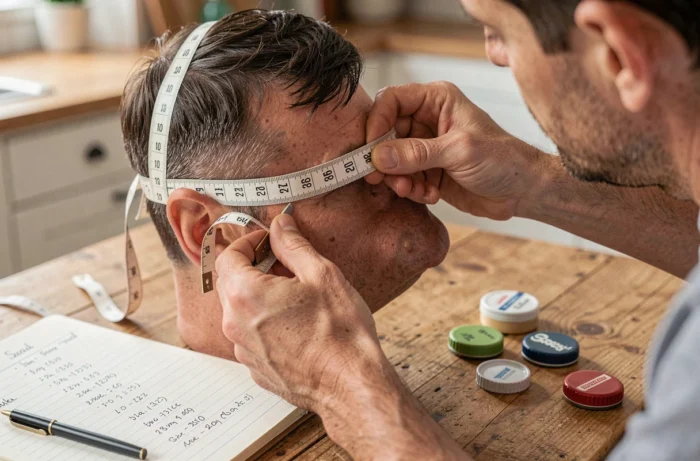
The head circumference, expressed in centimeters, remains the reference measurement for choosing a men’s cap. It is taken with a flexible measuring tape placed horizontally above the ears and eyebrows. This value determines the correspondence with the sizes S, M, L, or XL displayed by manufacturers.
Crown depth and pattern: what head circumference doesn’t tell you
Two caps with the same inner circumference can produce a very different fit on the head. The reason lies in the crown depth, which is the vertical height between the inner band and the top of the panel.
A shallow crown barely descends on the skull and gives a high fit, very visible from the front. A deeper crown wraps more around the head and stabilizes better, especially in strong winds or while moving.
According to the Dirt Cheap Headwear buying guide, updated on September 26, 2026, it is recommended to check the crown depth in addition to the circumference before any purchase. To delve deeper into this issue, the men’s cap size guide details the correspondences between measurements and models.
The pattern also plays a role: a five-panel cap fits the skull differently than a six-panel model. The number and cut of the fabric pieces alter the pressure distribution, especially on the sides of the forehead.
Technical measurements of a cap: beyond simple circumference
Recent production sheets no longer limit themselves to inner circumference. GarmentSpec, in an article published on September 21, 2026, describes several measurement points used in manufacturing.
- Front height and side height: these determine the volume of the crown and the angle at which the visor projects relative to the face.
- Length and width of the visor: a short visor exposes the face more, while a wide visor better protects from the sun but alters the visual proportion of the cap.
- Width of the sweatband: a narrow band concentrates pressure on a fine line of the forehead, while a wide band distributes support better and improves comfort over several hours.
These technical measurements do not always appear on consumer product sheets. When they are absent, physically trying on the cap remains the most reliable way to assess the fit.
Fitted or adjustable cap: implications for size choice
An adjustable cap (snapback, strapback, velcro) tolerates a margin of error on head circumference. The closure system compensates for a few millimeters more or less. It is the simplest choice when the measurement is uncertain or when the cap is to be given as a gift.
A fitted cap works without an adjustment system. The size is fixed, often expressed in fractions of an inch in the American system. The differences between two consecutive sizes are small, sometimes a quarter of an inch. Choosing the wrong size immediately results in discomfort on the forehead or a model that slips.
For a fitted cap, the correspondence must be checked in the brand’s size chart. Universal conversions S/M/L are not sufficient, as tolerances vary from one manufacturer to another. A size L from one manufacturer may cover a different circumference range than that of another.
What to do between two fitted sizes
If the head circumference falls exactly between two references, the larger size generally offers more comfort, especially in hot weather. Heat slightly expands the fabrics and causes the scalp to swell. A very tight cap in the morning can become uncomfortable by the end of the day.

Face morphology and visual proportions of the cap
Size is not only about mechanical comfort. The cap alters the perceived proportions of the face, and the choice of shape must take morphology into account.
A round face gains structure with a slightly curved visor and a medium-height crown, which visually elongates the oval. An elongated face better supports a flat visor and a low crown, which widen the silhouette.
An angular face (defined jawline, prominent cheekbones) pairs well with structured panel caps, like classic baseball styles. Soft models, such as five-panel caps made of unreinforced fabric, soften the lines of the face instead.
Flat or curved visor: impact on appearance
The flat visor projects a horizontal line that widens the top of the face. It suits narrow or triangular faces. The curved visor frames the gaze and focuses attention on the center of the face. This choice is as much about style as it is about morphology, but it alters the perception of the overall size of the cap once worn.
Materials and deformation over time: anticipating size changes
Untreated cotton relaxes after a few weeks of regular wear. A cap made of cotton that was slightly adjusted at first will eventually gain a few millimeters in circumference. Polyester and nylon retain their initial dimensions better.
Felted wool, used in some high-end models, shrinks when exposed to moisture if untreated. Improper washing can irreversibly reduce the circumference of a wool cap.
The inner band acts as a shock absorber. A leather band gradually molds to the shape of the forehead and softens over time. A synthetic band retains its rigidity longer but offers less natural adaptation.
Choosing the right cap size therefore involves combining three parameters: the circumference measured with a measuring tape, the crown depth suitable for the shape of the skull, and the behavior of the material over time. A cap well-sized on these three axes stays in place without tightening and retains its shape season after season.