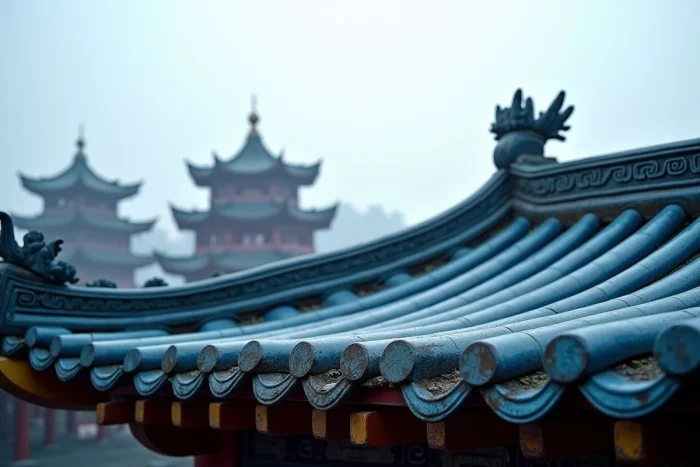
When you hover over a Chinese industrial area on Google Earth, the dominant blue of the roofs stands out even before zooming in. This omnipresent blue covers both recent warehouses and restored temples, but the reasons behind these two uses have almost nothing in common. Understanding blue roofs in China means untangling an ancient symbolic tradition from a purely functional material choice.
Glazed tiles and corrugated metal: two blues, two logics
The first instinct when observing blue roofs in China is to look for a single explanation. One quickly encounters cultural reasons linked to imperial dynasties. The problem is that the majority of blue roofs visible today are not glazed tiles placed on palaces.
On industrial buildings and recent rural homes, the blue comes from pre-coated steel sheets, mass-produced since the 1990s. This material is inexpensive, lightweight, and quick to install. The standard blue pigment is cheaper than other shades in mass production, which explains its massive presence in special economic zones and urban peripheries.
To delve into the historical and symbolic dimension behind blue roofs in China, one must go back to the techniques of glazed ceramics that adorned imperial and religious buildings, a completely different realm.
Color symbolism on Chinese imperial roofs
In traditional Chinese architecture, the color of a roof was not a free aesthetic choice. It followed a strict code related to the social rank of the owner and the function of the building.
- Yellow (or gold) was reserved for the emperor and imperial palace buildings. Using this color without permission was a crime.
- Green and turquoise covered temples, monasteries, and residences of high officials. These shades referred to wood, spring, and growth in Chinese cosmology.
- Pure blue, rarer on ancient buildings, was associated with the Sky (Tian). It can be found on the Temple of Heaven in Beijing, whose deep blue glazed tiles symbolize the celestial vault.
- Black and gray covered ordinary homes, without any particular symbolic pretension.
This system of correspondences between colors, natural elements, and social hierarchy is based on the theory of the five elements (wuxing). Blue represents the wood element and the east direction, which gives it a protective charge in Chinese cosmological thought.
Manufacturing blue tiles: glazes and high-temperature firing
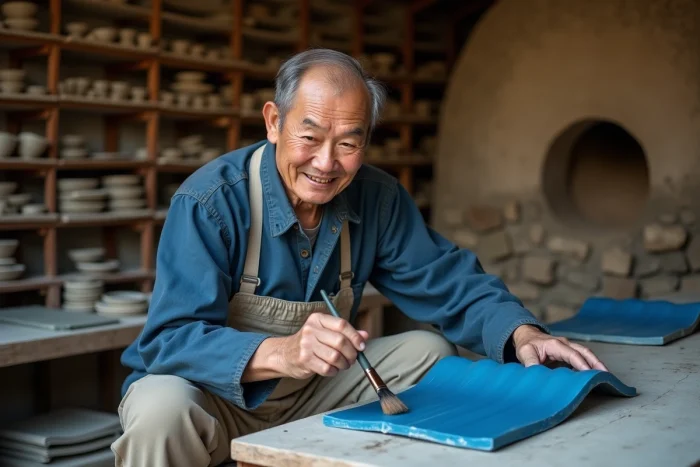
The glazed tiles (liuli wa) that adorn the roofs of historical buildings are not painted afterward. Their color comes from a mineral glaze applied to raw clay, then vitrified by high-temperature firing in specialized kilns.
To achieve blue, artisans traditionally used cobalt oxides mixed with a silica-based glaze. Cobalt, even in small quantities, produces an intense and stable blue once fired. This technique shares common principles with the production of blue and white ceramics that have made Jingdezhen famous.
The difficulty lay in controlling the temperature and atmosphere of the kiln. Under-firing resulted in a dull glaze, while over-firing could turn the shade gray. Reports vary on this point according to sources, as the exact recipes differed from one imperial workshop to another and were closely guarded.
What distinguishes ancient tiles from current reproductions
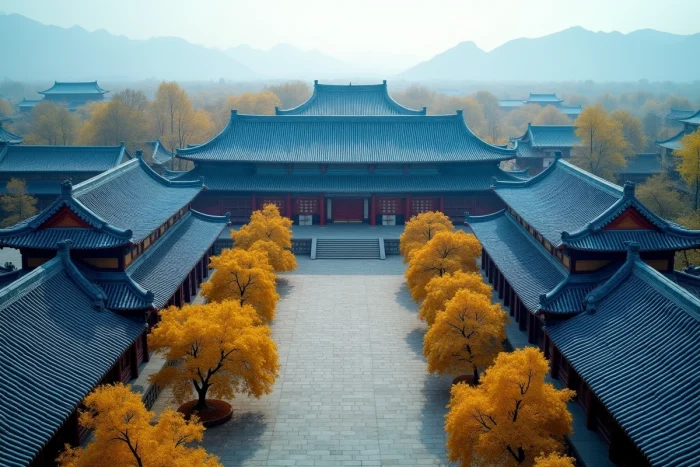
The glazed tiles seen on restored temples today are often industrial reproductions. They use more consistent synthetic pigments and standardized firing. The visual result is similar, but the texture of the glaze differs: ancient tiles show slight color irregularities, micro-cracks, and a patina that reproductions do not replicate.
On a restoration site, differentiating an original tile from a copy requires close examination of the surface and sometimes a chemical analysis of the glaze composition.
Why blue still dominates rural and industrial roofs in China
The link between the imperial blue of temples and the industrial blue of warehouses is indirect, but not nonexistent. The cultural familiarity with this color facilitated its massive adoption when corrugated metal manufacturers offered blue as a low-cost standard shade.
Several practical factors reinforce this dominance:
- The blue pigment for pre-coated steel is among the cheapest to produce in large quantities, benefiting builders looking to cut costs.
- Light blue reflects more solar radiation than dark shades like black or brown, limiting the heating of non-air-conditioned buildings.
- In some municipalities, local regulations encourage or require light colors for roofs in industrial areas, for the sake of visual uniformity and thermal management.
The result, seen from the sky, is this characteristic blue mosaic that is immediately recognizable on satellite images of medium-sized Chinese cities.
The coexistence of these two realms, one symbolic and ancient, the other economic and contemporary, makes Chinese blue roofs a rare case where a color transcends eras while completely changing function. The blue of a Ming temple and that of a Guangdong warehouse do not tell the same story, but they share a visual anchoring that centuries of practice have made familiar across the territory.